Social Icons

Saturday, August 2, 2014

2014 Doug Flutie 5K Training (Week 2)

D o u g   F l u t i e   5 K  T r a i n i n g
S t a t u s   R e p o r t
 
Training is on-going. So far to day I have run 7.41 total miles since I started training with 5.9 miles this week alone. My average per minute this week is 9:37. If I can maintain that pace for the entire 5K I will beat my previous time. Time is ticking and there are only 64 more days until race day.  I did manage to recruit another person to run so our little team is up to 3 people. For more information visit the Doug Flutie Foundation, or Doug Flutie 5k Info and Sign-up page

 SundayMondayTuesdayWednesdayThursdayFridaySaturday
7/20OffOffBravoOffBravo1.42miOff
7/271.42miOffBravo+.87Mi1.41miBravo+.87Mi1.42miOff
8/3RUNOffBravoRUNBravoRUNOff
8/10RUNOffBravoRUNBravoRUNOff
8/17RUNOffBravoRUNBravoRUNOff
8/24RUNOffBravoRUNBravoRUNOff
8/31RUNOffBravoRUNBravoRUNOff
9/7RUNOffBravoRUNBravoRUNOff
9/14RUNOffBravoRUNBravoRUNOff
9/21RUNOffBravoRUNBravoRUNOff
9/28RUNOffBravoOffRUNOffOff
D o u g   F l u t i e   5 K  R a c e   D a y  O c t o b e r   5 t h ,   2 0 1 4

7/27:  Ran 1.42 miles in 13:20. Avg/Mi 9:24. It was a good run. It was a little slower then my first fun but only by 6 sec/mi. my next run I am going to push myself to closer to 2 miles. I need to push myself a little harder to go a little further and a little faster. To think when I was in high school running track and field I was averaging a 6:30.

7/29: Today we didn't do the usual 12 Station Bravo Workout: Instead we opted to take our workout outside and have a more crossfit style session. It was a 20 minute AMRAP (as many rounds as possible).  The AMRAP included 10 wall balls, 10 KB Swings, 10 Air Squats, 10 Pushups, and a 200 meter run. in the 20 minutes. I did 7 full rounds. So that's almost a mile of running too.

7/30: Ran 1.41 miles in 13:16. Avg/Mi 9:23. It was a tough run by the end I as feeling it. I think I are too much earlier in the day and I was definitely paying for it. I am thinking I might start running in the mornings rather then after work. I definitely have more energy in the AM then I do in the PM

7/31: Another round the same as Tuesday's Crossfit style AMRAP. The AMRAP included 10 wall balls, 10 KB Swings, 10 Air Squats, 10 Pushups, and a 200 meter run. in the 20 minutes. I did 7 full rounds and made it 4/5 of round 8. The humidity had been the toughest part this week. I am looking forward to a little cooler weather.

8/1: Ran 1.42 miles in 14:18. Avg/Mi 10:06. It was a very tough run the humidity was high with the rain coming and my shins were killing me. I might take off my next training day to allow them a chance to heal.


Week 1 | 2 | 3 | 4 | 5 | 67 | 8 | 9 | 10 | 11 | Race Day

Salisbury Mansion & Store Tour

Salisbury Mansion was the home of Worcester’s wealthiest family in the late 1700’s and early 1800’s. It served many purposes but mainly as the location of the Salisbury Family’s Worcester branch of their hardware store.

The family came from humble beginnings and it was only with an unexpected inheritance from England did the family get into the hardware business. In 1767 Stephen Salisbury was sent to Worcester by his brother Samuel to open a store at the young age of 21. When the operation proved profitable he built the Salisbury mansion in 1772 to serve not only as his home but as the store and located it at the north end of Lincoln Street at Lincoln Square.  He had decided to build a single building to serve both purposes to allow him to better serve the needs of those who purchased goods from him.

The home was built in the Georgian style and looked quite different than it does today. It was built primarily as a store and storage for goods. The residence was a total of 4 rooms on the left side of the house. It was there that bachelor Stephen Salisbury lived when not working. The store was a success making him the wealthiest man not just in Worcester but in all of Worcester County. The home wouldn’t have impressed the wealthy Bostonians it was considered a Mansion in rural Worcester.

When the British came to Boston the home played house to 8 more people. To escape the city he played host to his Brother Samuel and his family as well as his mother beginning in 1775. They stayed for 8 years before returning to Boston. At this time an addition was built onto the back of the home to serve as the kitchen and more living quarters.

In 1797 Stephen married Elizabeth Tuckerman, a young lady 21 years his junior.  He was 51 and she was 28 and the daughter of one of his business associates. They had three children. Only one of their children lived more than a few years and making it to adulthood.

The Embargo of 1812 spelled the end of their hardware stores since they had been cut off from the many goods they imported from England. Thankfully the family had well invested store profits in other areas such as real estate and canal building which assured them of the financial safety.

By 1820 all of the space once used for the store had become living quarters and the home’s exterior also changed the main entrance of the home shifted from the side to the front where the store entrance had been. The former store space was renovated and featured elegant Federal detailing, a proper through-hallway with pattern book entry surrounds, and a columned front portico. This 1820 renovation expanded the living space to include double drawing rooms, a library, and chambers above for family and staff use.

In 1929 Stephen Salisbury died leaving his widow Elizabeth Tuckerman Salisbury in the home. She was the last of the Salisbury’s to inhabit the home until 1851.

Her son Stephen Salisbury II a Harvard graduate, enjoyed a brilliant career as a gentleman farmer, industrial developer, leader in civic, cultural, and political affairs, world traveler, and all-around Renaissance man. He had built himself a home of his own and when his mother passed he had no use for it and sold off all the contents at auction.

His son Stephen Salisbury III also a Harvard graduate spelled the end of the Salisbury line in Worcester. Like his father, he became a prominent leader in cultural and community affairs in Worcester.  He remained a life-long bachelor, reportedly preferring the company of his horse to many of his acquaintances.   At his death, Stephen left his substantial fortune to Worcester civic, cultural, educational, and health care organizations.

The home future however seemed murky. The once grand home then became girl's school, tenant house, and then a gentleman's social club until 1929, when the building was donated to the American Antiquarian Society. In 1929 the home was relocated from its original location up the hill to make way for a new Memorial Auditorium. Parts of the home like the addition didn’t make the move. It was then given to the Worcester Art Museum.  In 1975 it was listed on the National Register of Historic Places. It was leased to a nonprofit, and eventually acquired by the Worcester Historic Museum in 1985. The museum undertook to restore the much-altered building to its condition as of 1830, and opened it as a museum. It is considered one of the best documented historic house museums in New England.

It is the mission of the museum to try and re-acquire as many of the original pieces that had been sold at auction. Some pieces have returned and today visitors to Salisbury Mansion today can see household furnishings and decorative arts that range from early 18th century Queen Anne to 1820s Boston Classical.  Perhaps the most stunning piece on exhibit is Stephen Salisbury’s standing desk, purchased from a Boston cabinetmaker in 1772.  Also eye-catching is the heavy Boston Classical sofa with falcon heads embellishing the front legs, part of a suite of furniture purchased from Isaac Vose & Son of Boston in 1820.  Other Salisbury pieces include a set of Vose chairs, an 18th century harp, two 19th century sofas, and ceramics.


Salisbury possessions are complemented by artifacts representative of the furniture listed in an 1851 inventory of household goods, written by Stephen Salisbury II prior to selling them at a public auction after the death of his mother, Elizabeth Tuckerman Salisbury.

What struck me most about this amazing home was its condition. I was a bit surprised to find that it wasn't maintained as well as I would have hoped or expected. I noticed peeling paint, stained wallpaper, cracked glass and grounds that were poorly taken care of. I don't expect a perfect home since after all its 242 years old but it's part of the history of the city of Worcester and I hope that as the Worcester Historical Museum continues to work towards preserving it that they might try to ensure that it will last for another couple hundred years. I would also hope that perhaps the city will donate the municipal parking lot to the museum to allow them to enlarge the front lawn and have the exterior compliment rather then detract from the home.


Our guide/docent for the day was very knowledgeable about the home and the family and was able to answer many of the questions we asked. He took us around each of the rooms and explained its purpose and how its changed over time. He also explained how each family member impacted the home. It was an enjoyable visit and a learning experience.

Wachusett Brewing Company Tour

We arrived at a very non-descript building located off a rural road in Westminster, MA. This 
building is home to Wachusett Brewing Company. Parked in front was a vintage fire truck emblazoned with the logo and Wachusett Brewing Company name.
Admittedly we were a little early for the 12:00 opening and knew we would need to wait. It wasn’t long before employees started to arrive and customers began filling the parking lot. Many had their own growlers with them and were there to have them re-filled. Others like us where there for the tour.


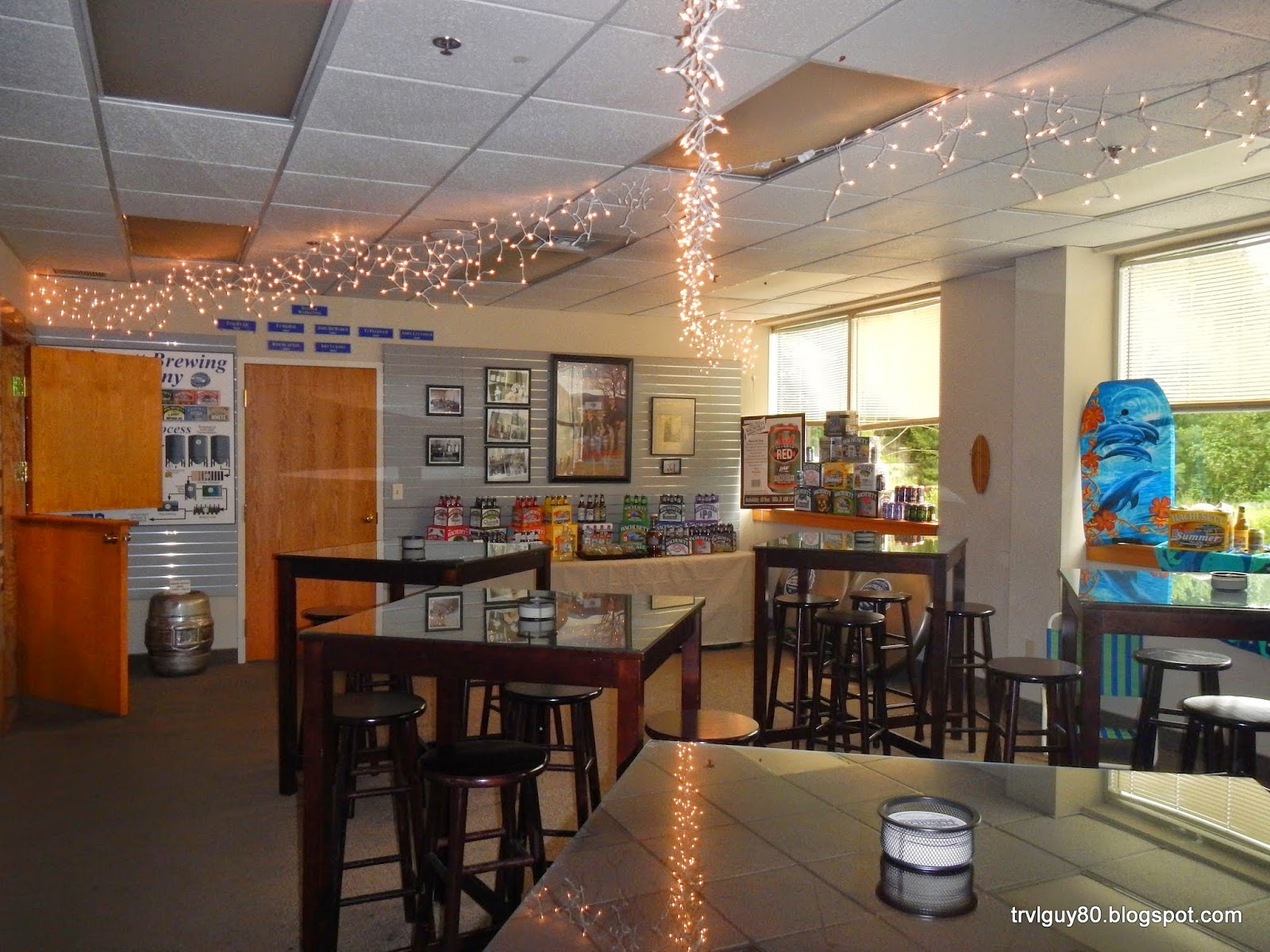
Those of us there for the tour gathered in the tasting room where we meet Heather our tour guide for the day. She started us off the right way by offering us a sample of one of the 11 of their different brews on tap.


I selected their newest brew the Strawberry White and Dan selected their trademark brew the Country Pale Ale. The Country Pale Ale was the first of their many different brews. After picking up our complimentary samples we took a seat at one of the many high top tables.

Heather started with a quick explanation of how Wachusett Brewing Company was founded. We learned that it was founded by three WPI students who all had an appreciating for home-brewing. The founders Ned, Kevin and Peter who were either engineering or biology majors put their education to work experimenting until they got the formula just right.


The walking tour of the brewery begins every hour on the hour. The full brewery tour takes about 30 - 45 minutes and is offered on Saturdays. Your tour guide will give you a brief history of the brewery and walk you through our brewing, cellaring and packaging. Children are welcome, but of course may not taste beer during our tasting session, which follows the walking tour. Altogether, the tour and the tasting last for about 1 hour, and tastings are limited to two (2) 2oz. samples.


We learned that the red barn depicted in many of the labels represents Ned’s Family farm in Westminster where they first brewed their beer. They stopped brewing their beer on the farm after they produced so much that they ran the well dry. The well supplied not just the barn but Ned’s parents’ home. The parents decided it was time for them to move their operation out of the barn and they moved into a portion of the current facility.


Many of their equipment was re purposed from other things such as the shrimp steamer now used as their mash pit. In 1994 they started distribution with clear growlers which they cleaned sanitize, hand fill and deliver to the local package stores. When you purchased one you would leave a deposit of $5 for the growler which if you returned it you would receive back. Those empty growlers would be returned to Wachusett Brewing Co where the process would start again. They also started with bunk style keg’s which were hard to fill and dispense from. In 1997 they began bottling.  They changed their growlers from the clear glass and began using light block growlers imported from Germany in 2004. They will hold 5.5-6 beers. The beer lasts for about 1-1.5 weeks unopened once opened it will last just a few days. In 2010 they changed kegs to the straight walled kegs which are both easier to fill and pour from.

1994 Wachusett Brewing Co was producing 40 Kegs per week, today we do 3000 cases of bottles, 5000 cases of cans and 500 kegs in an 8 hour day. As a local craft brewery they brew roughly 30,000 barrels of beer in a year.


They are currently the second largest brewery in Massachusetts behind Harpoon. Sam Adam’s no longer brewed volume in their Jamaica Plain facility just specialty and small batches. They lead the way for Wachusett to take that No. 2 spot. They also have the only canning machine in the state and can beer for other brewers.


There are four things that make a craft beer. Water is the first and the founders are passionate about the area and they use the town water from the Fitchburg reservoir. It is triple filtered and they occasionally add salts. The second ingredient is the wheat and barley which affects the strength, smells, and taste. They also use a 2-row malt. The lower the number of rows the better the quality. There are 22 different varieties of grain used to provide different flavors in the many brews.

The third ingredient they use is hops which they get in pellet form from Washington State. They also grow a small amount locally which they occasionally produce special batches with. Hops grown on a vine up to 25 feet tall.


They fourth ingredient is yeast. There are two different types of yeast. Top fermenting of bottom fermenting yeast. Top fermenting yeast produces ale’s and bottom fermenting yeast produces lagers. The yeast eats through the sugars which then produces alcohol and carbon dioxide.


With that background of Wachusett Brewing Company we got a second sample. Dan and I both chose the Blueberry Ale. Once done with those samples we moved on to the production floor where we first entered the packaging area. This area serves as both as a shipping and receiving area. On one side newly brewed bottled and canned beer is palletized and then their newest tool the orbital wrapper shrink wraps those pallets to ready them for shipping. On the other side bottles and can’s are de-palletized and sent for cleaning and sanitizing.


The 22 different varietals are selected for which ever brew is being produced. Those selected grains are put in the grist grain mill where the wheat and malted barley are ground up and put in their modified shrimp steamer now mash tun. 600 gallons of water are flooded into the Mash and brought up to 160-165 degrees for 75 minutes. You don’t want it to boil you just want the sugars to steep.  This produces a product called wort which is then brought to the brew kettle. All of the grain is pulled off and is trucked to local dairy farms to feed the cows.

The magic happens in the brew kettle. It boils in the brew kettle and the hops are added and it stays in for 75 minutes. It’s too hot to go directly from the brew kettle to the fermenting tanks so it passes through the whirlpool. Once down to temperature it is ready to be moved to one of their fermenting tanks.  From the grist mill to the fermenter takes roughly 5.5 hours.


In the tanks the yeast is introduced at the bottom of the tank and it eats its way to the top. This is top fermenting yeast and produces ales. The yeast eats all the sugars and produces the alcohol and carbon dioxide. The carbon dioxide bubbles out into buckets of water and is released and the alcohol stays inside the tank. Brews stay in for a pre-determined period of time based on the particular recipe. It is here that samples are brought to the lab to test and ensure that they brewed correctly and to determine if they are ready. This can take up to 2.5 weeks or as little as 1 week.

These fermentation tanks range from 70 brewers barrels to 180 brewers’ barrels. One brewer’s barrel is equal to 2 kegs and a keg is 15.5gallons so each run produces 140 – 360 kegs.

Once fermentation is complete its filtered or left unfiltered before entering the Bright Beer Tanks to finish. ½ is filtered and ½ of the different brews are filtered. The filtering process takes place the DE filter or diatomaceous earth filter. It is very similar to a pool filter but it is food grade. Then it is placed in the bright tank where the beer is force carbonated. It is aged and conditioned in these tanks. Depending on the brew and alcohol content it can take 5 days to 1 week in the finishing tank.

The operation is a 24/7 operation. If it is ready to be bottled or canned it can take place at any hour. The employees are brought in and it is completed. As mentioned earlier they are the only canner in the state of MA and often other brewers ask them to can their beer. In one of the bright tanks we noticed that they had BBC Steel Rail which was soon to be canned.


Next is packaging. Wachusett can package their beer in can’s, bottles and kegs. They can keg 60 full kegs a minute when they are at full steam. The can’s come like a glass which is washed cleaned and sanitized. It is spun to remove any residual water before it is filled. Then the top is applied and seemed and sealed. Each can is x-rayed and checked for a complete fill.  They purchased their canning machine from Coca Cola when they closed down their Bermuda cannery. Once canning is complete they are bound into six packs and into cases then sent to the palletizer.

The bottling happens at the bottle fill station. They are cleaned and sanitized similarly as the can. They are shot with one drop of liquid nitrogen which not only cleans and sanitizes but forces all the air from the bottle. They are filled from the bottom to the top where it is capped and then sent to the label machine. Once labeled they are put into boxes and then cased and sent to the palletizer.


That is the whole process of making beer and distributing it to vendors for sale.